Quick answer
Seattle's most iconic landmarks grew out of three big moments. The Klondike Gold Rush of the late 1890s turned the city into a boomtown supply hub, Pike Place Market opened in 1907 to give shoppers a fair deal, and the Space Needle was built for the 1962 World's Fair. Pioneer Square, rebuilt after the 1889 fire, is the original downtown, and Gas Works Park reopened as a public park in 1975.
Seattle wears its history in plain sight. A space-age tower, a century-old public market, a brick-and-stone old town, and a converted industrial plant on the lake are not just photo stops — each one marks a turning point in how the city grew. Here are the real stories behind the landmarks most visitors come to see.
The Klondike Gold Rush: the spark that grew a city
Before the towers and the tourists, Seattle was a modest port town. That changed almost overnight in the late 1890s, when news arrived that gold had been found in the Klondike region of Canada's Yukon. Thousands of hopeful prospectors poured through Seattle on their way north, and the city's merchants quickly realized the real fortune was in selling them everything they needed: boots, tents, food, tools and passage by ship.
Seattle marketed itself relentlessly as the gateway to the goldfields, and the strategy worked. The Gold Rush flooded the local economy with money and people, transforming a regional outpost into a fast-growing commercial center. The boom is remembered today at the Klondike Gold Rush National Historical Park in Pioneer Square — a fitting location, since that neighborhood was the beating heart of the city during those frantic years.
Pioneer Square: the original downtown and the underground
Pioneer Square is Seattle's oldest neighborhood and its first commercial district. Much of what stands there now exists because of a disaster: the Great Seattle Fire of 1889, which destroyed roughly thirty city blocks of the mostly wooden downtown. Remarkably, no lives were lost, and the city used the catastrophe as a chance to rebuild smarter.
The new Pioneer Square went up in brick and stone, giving it the handsome, uniform architectural character you can still walk through today. During reconstruction the city also raised the street level to improve drainage. The old ground-floor storefronts were left buried below the new sidewalks, creating the network now explored on tours as the Seattle Underground. It is one of the few places where you can literally walk through the layers of a city's history.
Pike Place Market: a fair deal since 1907
Pike Place Market opened in 1907 to solve a very practical problem. Shoppers were frustrated by middlemen who marked up the price of produce, so the city created a public market where farmers could sell directly to customers. The idea was an instant success, and the market grew into a sprawling collection of stalls, shops and eateries perched above the waterfront.
More than a century later, Pike Place is one of the oldest continuously operated public farmers' markets in the United States. Its original "Meet the Producer" spirit still holds: many vendors are the people who grow, catch or make what they sell. Between the fish throwers, the flower stalls and the maze of lower levels, the market remains a living piece of Seattle history rather than a museum of one.
The Space Needle: built for the future, in 1962
The Space Needle is the most recognizable thing in the Seattle skyline, and it was built for a single event: the 1962 World's Fair, officially called the Century 21 Exposition. The fair celebrated a forward-looking, space-age vision of the future, and organizers wanted a structure that captured that optimism. The result was the Needle, with its slender legs and saucer-shaped top house holding a restaurant and an observation deck.
The tower was designed and built in a remarkably short window to be ready for the fair's opening, and it was engineered to withstand the region's high winds and earthquakes. What began as a temporary fair attraction became a permanent civic symbol, the way the Eiffel Tower outlived the exposition it was built for. Today it anchors the Seattle Center grounds, surrounded by museums and venues that also trace their roots to that 1962 fair.
Gas Works Park: industry turned into a park
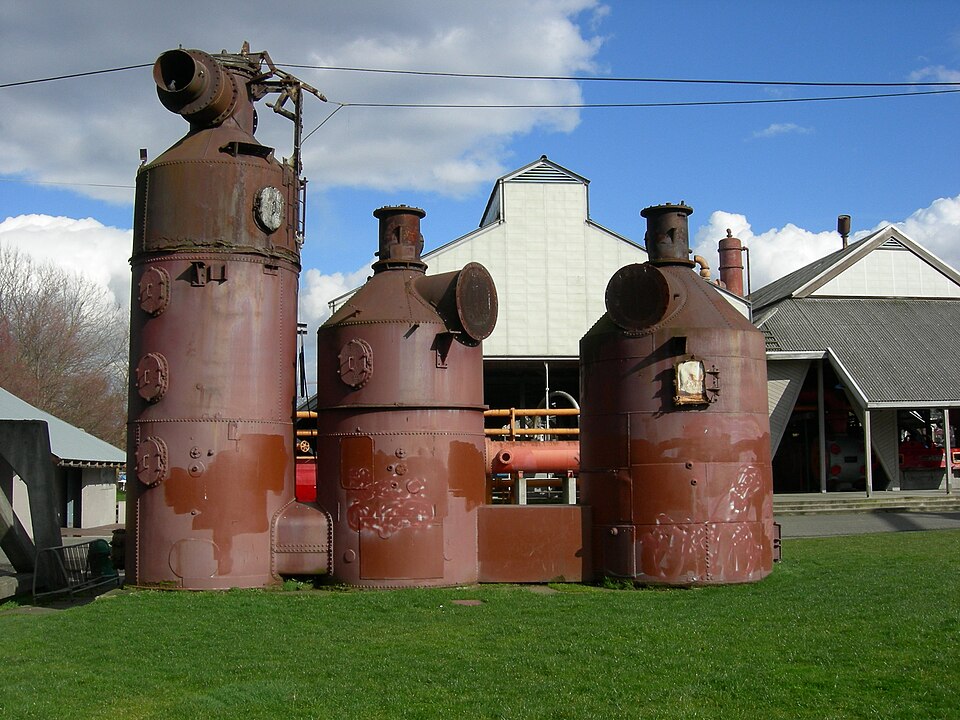
Few city parks have a stranger past than Gas Works Park. The site on the north shore of Lake Union was once a plant that turned coal, and later oil, into gas for heating and lighting the city. When natural gas made the plant obsolete, it was shut down and left as a hulking industrial relic.
Rather than demolish everything, designers chose to keep much of the old machinery in place and build a public park around it. Gas Works Park opened in 1975, and its preserved towers and pipes now sit among open lawns and one of the best skyline views in the city. It stands as an early, influential example of reclaiming an industrial site for public use instead of erasing it.
Seen together, these landmarks tell the story of a city that turned a gold rush into growth, rebuilt itself after fire, and kept reinventing what it inherited. If you want to trace that arc in a single day, see our routes and shuttle options to plan the trip.